


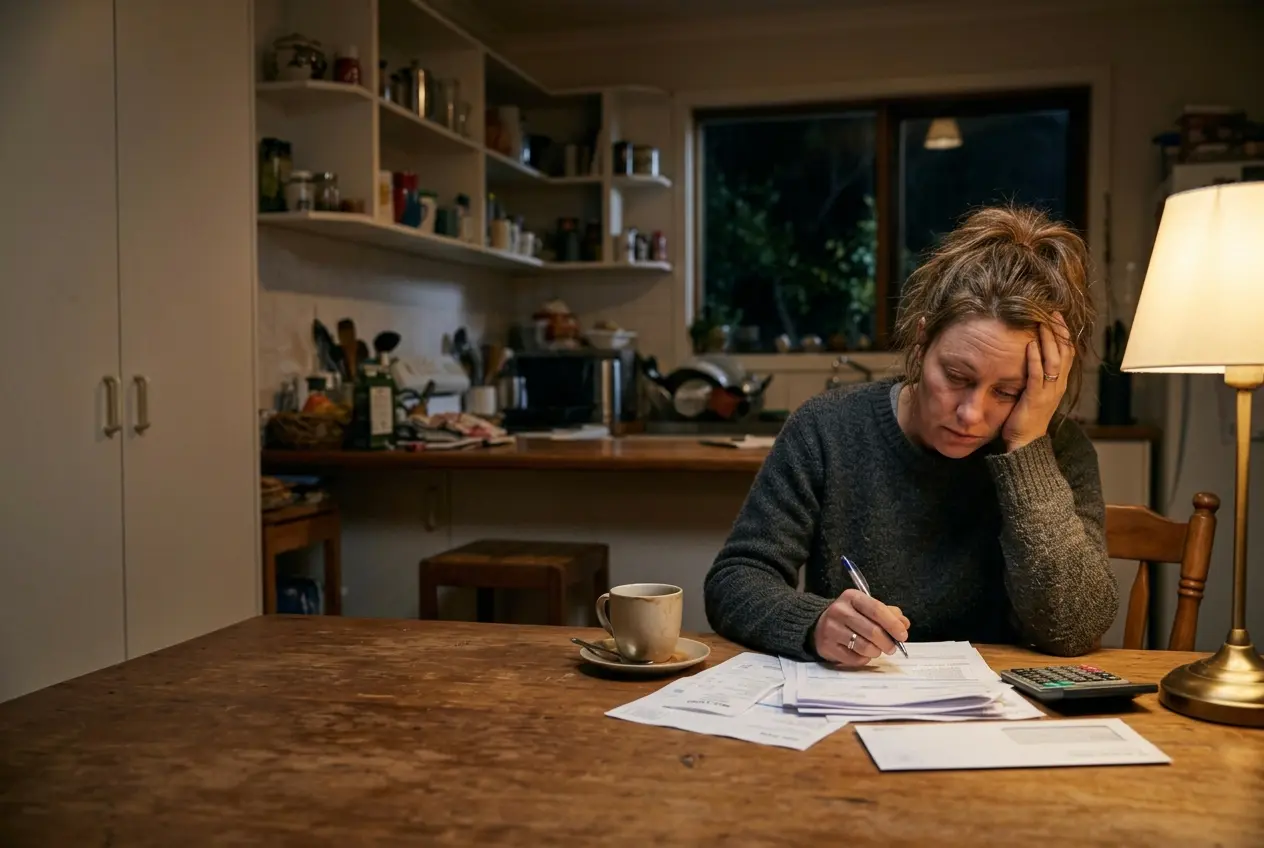
There's a particular kind of tiredness that comes with being the only adult in the house. So what do single mothers struggle with the most? Money comes first for most of us. But it's rarely only money.
Underneath the bank balance sits something harder to name. Every decision lands on one person. Every bill, every school note, every sick day, every call about whether you can afford the excursion.
Australian data backs the money answer. One-parent families report higher financial stress than couple families across most measures. But ask a room of single mums and the word that comes up isn't "broke". It's "alone with it."
Quick Takeaways:
- Money is the struggle most mums name first. One-parent families with dependent children report higher rates of financial stress than couple families across multiple ABS measures.
- Single mothers head three-quarters of one-parent families. In June 2025 there were 1.2 million one-parent families in Australia, and 77% were headed by mothers.
- Most single mums already work. A parent was employed in 73% of one-parent families with dependents, so a job on its own doesn't solve the money problem.
- The mental load is the quiet one. Being the only decision-maker wears mums down more than any single expense does.
This article is for general informational purposes only and is not a substitute for professional mental health support. If you are struggling, please reach out to a qualified professional or contact Beyond Blue on 1300 22 4636.

What Do Single Mothers Struggle With The Most?
Money, the mental load of being the only decision-maker, and time. Financial stress is the easiest to measure. One-parent families report higher financial stress than couple families across most Australian measures. The load of sole responsibility is harder to count, but mums name it just as often.
Those three feed each other. Less money means more work hours. More work hours means less time. Less time means every decision gets made while exhausted.
Money: The Struggle Sitting Under All The Others
Money shapes almost everything else on this list. It decides where you live, how many hours you work, and how much choice you actually have on a Tuesday afternoon.
What The Australian Numbers Show
In June 2025, there were 1.2 million one-parent families in Australia, 16% of all families. Mothers headed 77% of them. Of the 752,000 with dependants aged 0 to 24, 79% were headed by a single mum.
Most single mums work. A parent was employed in 73% of one-parent families with dependants. Work is not the missing piece people assume it is.
The stress shows up anyway. One-parent families with dependent children were more likely to report higher financial stress than couple families across multiple indicators in the 2025 General Social Survey.
I used to think this was a budgeting problem. Actually, that framing isn't right. Most single mums I know budget better than anyone I've met. The income is thin, and the fixed costs are not.
One note on payments. I've left the exact Parenting Payment amount out of this article on purpose. Rates change twice a year, in March and September, so a number printed here would be out of date within months. The current figure sits on the Parenting Payment page, and it's worth checking what you can claim alongside it. There's a fuller rundown of single parent benefits if you want the wider picture.
Housing: The Cost That Changes Everything Else
Rent is the highest fixed cost most single mums carry, and it's the one you have the least control over. It's also the reason the money problem doesn't respond to budgeting.
Anglicare Australia's 2026 Rental Affordability Snapshot looked at around 49,000 rental listings across the country. A person working full-time on the minimum wage could afford 0.5% of them. That's about one listing in every two hundred. Single-parent households were among the worst affected of every household type tested.
Where you live then sets everything else. The commute. Which school. Which childcare has a place. How many hours you can work before pick-up. A cheaper suburb an hour away often costs more once you add petrol, before-school care and the hours you lose.
So the standard advice, just move somewhere cheaper, misses a lot. There's the bond, the moving costs, the rental applications you'll lose, and the disruption of changing schools mid-year. Sometimes it's still the right call. It's rarely the simple call people make it sound.
Two things worth checking. If you get Parenting Payment, Services Australia assesses you for Rent Assistance without a separate claim, but only against the rent details they have on file, so an old figure can quietly cost you. And most state housing registers have long waits, which means joining early matters more than waiting until things get worse.

The Mental Load Nobody Sees On A Roster
The mental load is the thinking, remembering and deciding that never appears on anyone's list. In a two-parent house it can be split badly. In a single-mum house there's no one to split it with.
It looks like this. Book the dentist. Notice the shoes are too small. Remember which kid hates tomato this month. Sign the excursion form. Work out whether that noise in the car is going to be expensive.
None of it is hard on its own. All of it, every day, with no second brain, is.
There's a name for what happens next: decision fatigue. It just means your judgement gets worse the more choices you've had to make. By 6pm you're not choosing badly because you're careless. You're choosing badly because you've already made four hundred decisions since the alarm went off.
This is the struggle mums underestimate in themselves. You can be coping fine financially and still be flattened by the deciding. If your head feels permanently full, managing that overwhelm is its own skill, separate from managing money.
Why Does Time Feel Like The One Thing You Never Get Back?
Because there's no handover. Work hours and parenting hours don't overlap, and there's no second adult to absorb the gap between them.
Here's the trade-off, honestly. More work hours brings in more money and takes hours from the only person who can do the school run. Fewer hours protects the parenting and thins the income. Neither is the wrong choice.
It depends on your kids' ages, your childcare, and how flexible the work really is. If you're close to work with school-aged kids, extra hours can stack up well. If you're an hour away with a toddler in care, they often don't.
The cost of getting this wrong for too long is single mum burnout, which is a real thing and not a character flaw.
What If You Don't Have A Village?
Every article on this topic says build a support network. That advice quietly assumes there's one there to build.
Plenty of mums don't have family nearby. Some have family nearby who make things harder. Some moved for a job, some moved away from something unsafe, some never had that kind of family at all.
The gentler version is this. You don't need a village. You need two or three specific people who can do one specific thing.
- One person who can collect a kid in an emergency.
- One person you can text at 10pm without explaining yourself.
- One swap with another mum: you take her kids Saturday morning, she takes yours Sunday.
That's it. That's the whole network. It's much smaller than the advice implies and far more achievable. Asking for help is usually the hard part, not the finding.

Loneliness, Or Something Heavier?
Most single mums feel lonely sometimes. That's ordinary and it passes. What's worth paying attention to is loneliness that stops lifting.
Ordinary loneliness arrives in moments. The house after bedtime. The weekend the kids are at their dad's. It has a shape and it moves on. Coping with loneliness is mostly about having something ready to fill those specific gaps.
Something heavier looks different. Days when getting up feels beyond you. Not enjoying things you used to enjoy. Feeling flat for weeks rather than nights. That's worth raising with your GP, and there's no threshold you have to reach first.
If you want to talk to someone tonight, Lifeline is on 13 11 14 and Beyond Blue is on 1300 22 4636, both 24 hours. If you're worried about your safety or your kids' safety, 1800RESPECT is on 1800 737 732.
The Co-parenting Admin That Never Ends
If there's another parent in the picture, the admin of that relationship is its own struggle. Nobody counts it and it takes real hours.
Changeover messages. Chasing a yes on a school form. Working out whose weekend the birthday party falls on. Keeping a record in case you need one later.
Some mums have an ex who answers texts and shows up. Some don't. Both are common, and neither says anything about you.
Where it's tense, the thing that helps most is dull. Keep it written, keep it short, keep it about the kids. There's more on communicating with your ex if that's the part draining you.
And for plenty of mums there's no other parent at all. Widowed. Never-partnered. Solo by choice. A grandmother or aunt raising kids that aren't hers by birth. That version trades the co-parenting friction for something else: no one to hand over to, ever, and a lot of forms that assume a second name. Different struggle, same weight.
What Actually Helps, Ranked Honestly
Not everything that gets recommended is worth your Saturday. My rough order:
- Claim everything you're entitled to. More mums miss Rent Assistance and state concessions than miss Parenting Payment. Under-claiming is quiet money left on the table, and it compounds year after year in a way an extra shift never will. Services Australia's Payment and Service Finder is the fastest way to check.
- Buy back hours, not just dollars. A childcare swap, a cleaner once a month, an earlier bedtime. Hours are the scarcer thing.
- Get your two or three people. Small and specific, as above.
- Sort the admin systems once. A shared calendar, one folder for documents, one spot for school notes. The setup is a pain, then it stops costing you.
- Fix the sleep before the self-care. A face mask on four hours' sleep does very little.
Budgeting apps sit lower than most articles put them. They're fine, and for many mums they mostly distract from the bigger picture, which is income and fixed costs. If your rent moved, an app won't fix it.
Charities and community organisations are underused, partly because asking feels like a bigger step than it is. The Beanstalk Mums list of charities helping single mothers covers food, education costs and crisis support.
What This Article Doesn't Cover
Family law, child support disputes and property settlements. Those change the answer to nearly everything on this page, and they need advice about your actual situation, not a general article.
Exact payment amounts, for the reason above. And anything state-specific. Concessions, school costs, housing registers and Legal Aid all vary a lot depending on where you live.

The Thing To Take From This
So, what do single mothers struggle with the most? Money, then the weight of carrying every decision alone, then time. In that order for most of us, on most days.
But the thing I'd want you to walk away with is smaller than any of that. The struggle isn't evidence you're doing it badly. It's the arithmetic of one adult covering a job that was built for two. You aren't failing at something other people find easy.
Pick one thing this week. Check what you might be under-claiming, or ask one person to be your emergency contact. One is enough.
Frequently Asked Questions
What do single mothers struggle with the most in Australia?
Money, the mental load of being the only decision-maker, and time. ABS data shows one-parent families with dependent children report higher financial stress than couple families across multiple measures.
How many single mother families are there in Australia?
In June 2025 there were 1.2 million one-parent families in Australia, making up 16% of all families. Mothers headed 77% of them.
Do most single mothers work?
Yes. A parent was employed in 73% of Australian one-parent families with dependants as of June 2025.
What do single mothers struggle with more, money or the mental load?
Money is what most mums name first, because it shapes housing, childcare and work hours. The mental load is what more mums report as the thing that actually wears them down.
Is it normal to feel lonely as a single mum?
Yes, and it usually arrives in specific moments like the house after bedtime or a weekend without the kids. Loneliness that doesn't lift for weeks is worth raising with your GP.
Where can a single mum get support in Australia?
Services Australia handles payments and concessions, and Lifeline (13 11 14) and Beyond Blue (1300 22 4636) run 24-hour phone support. For safety concerns, 1800RESPECT is on 1800 737 732.
Does single motherhood get easier over time?
For most mums, the practical load eases as children get older and become more independent. The financial pressure often shifts rather than disappears, particularly as teenage costs rise.