


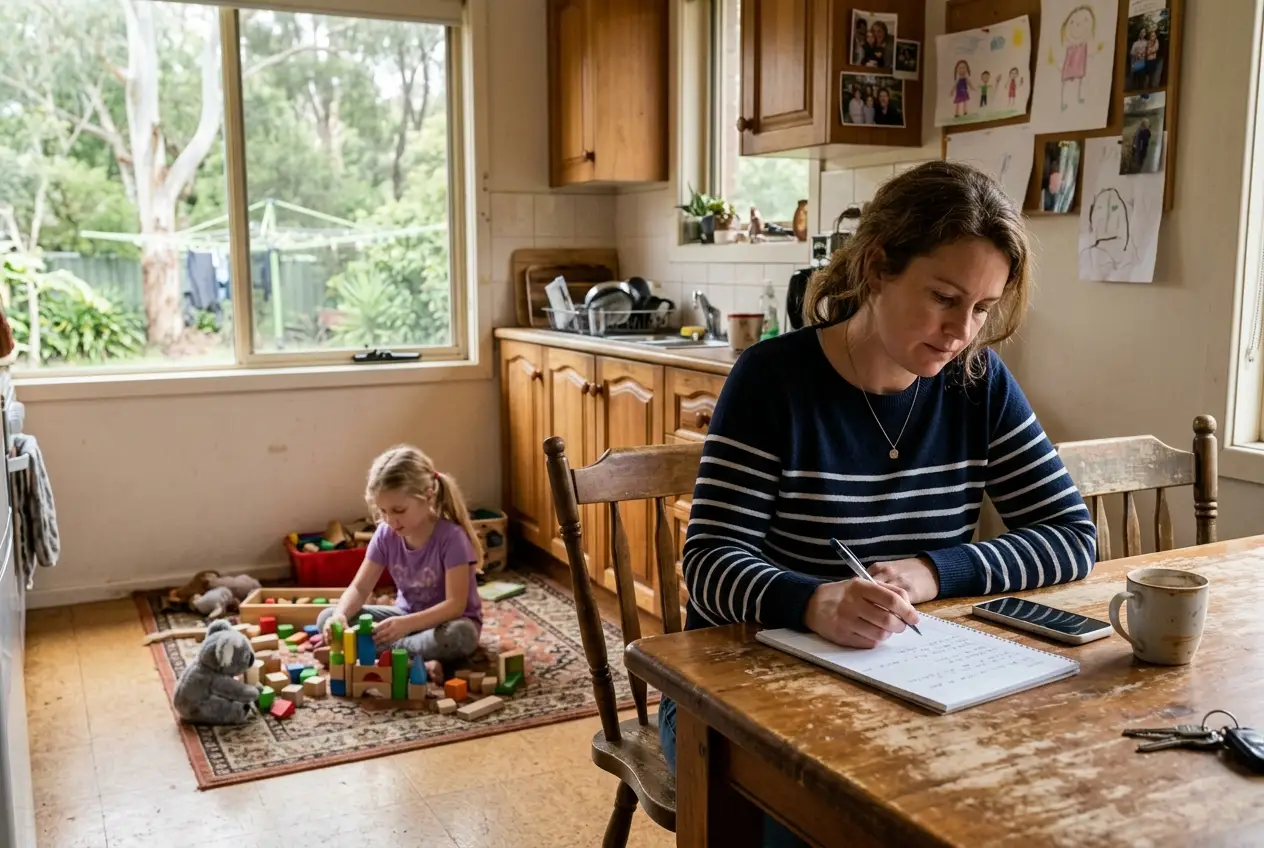
Most mums I know don't lie awake over the budget. They lie awake over the deciding.
Whether staying home is the right call. Whether they'll regret it in ten years. Whether they're even allowed to want it.
If that's you at 11pm with a browser full of tabs, nothing has gone wrong. You're weighing something real, on your own, with consequences either way. And nobody handed you the numbers to do it with. That's a lot to carry before you've even started.
So let's take the deciding off your plate for a minute. Let's just look at the numbers.
Can I afford to be a stay-at-home mum? On your own in Australia, it comes down mostly to your rent. A single mum whose youngest child is under 14 can get up to $1,066.30 a fortnight in Parenting Payment Single. That's from the current Parenting Payment rates that took effect on 20 March 2026. Add up to $257.88 a fortnight in Rent Assistance if you're renting, plus Family Tax Benefit for each child.
That's your starting point. What you build on it is yours.
I've sat at my own kitchen table doing this maths twice. Both times it felt smaller once it was written down. Let's do yours.
Quick Takeaways:
- Know Your Real Floor: A single mum whose youngest child is under 14 can get up to $1,066.30 a fortnight in Parenting Payment Single from 20 March 2026, plus up to $257.88 in Rent Assistance if you're renting. That's the base you're building on before any work income.
- Work Won't Cost You Everything: You can earn $224.60 a fortnight before your payment reduces at all, and it only drops by 40 cents in every dollar after that. One day a week of work leaves most mums around $389.84 a fortnight better off.
- Childcare Is No Longer The Trap It Was: Since 5 January 2026, every family eligible for the Child Care Subsidy gets at least three days of subsidised care a week, whether or not you work. The old activity test that locked mums out is gone.
- Plan For The Age 14 Change Early: Parenting Payment Single stops when your youngest turns 14, and you move to a payment worth $183.80 less a fortnight. Knowing that years out gives you room to plan calmly rather than scramble.
- Rent Is The Number That Decides It: Your rent drives this more than any budgeting tip. Getting your Rent Assistance right is worth up to ten times more than cutting the small stuff, so start there.
This article is general information only and does not constitute financial advice. Please speak with a qualified financial adviser before making any financial decisions.
What Staying Home Actually Means When You're The Only Income
For a single mum in Australia, staying home means living on Parenting Payment Single plus family payments. No wage coming in. The maximum is $1,066.30 a fortnight from 20 March 2026. You qualify if you're the principal carer of a child under 14 and you meet the income and assets tests.
There's one thing tucked inside that most articles skip over.
Once your youngest turns 6, you have mutual obligation requirements. Job search, study, or an approved activity, unless Centrelink gives you an exemption. So staying home the way a partnered mum means it really runs until your youngest starts school.
Can I Afford To Be A Stay-At-Home Mum In Australia?
It turns on your rent more than anything else. Low or subsidised rent with no debt behind you, and the numbers work. High city rent is where they get tight. And that's about the rental market rather than anything you've done.
What The Payments Add Up To
Your Parenting Payment Single is made up of four parts:
- Base rate: $1,017.20 a fortnight
- Pension Supplement (basic amount): $30.10
- Pharmaceutical Allowance: $7.00
- Energy Supplement: $12.00
Which comes to $1,066.30 a fortnight all up.
On top of that:
- Rent Assistance, up to $257.88 a fortnight if you're renting with one or two children
- Family Tax Benefit Part A and Part B, which varies with your child's age and your income
Those figures come from the Department of Social Services rates list dated 20 March 2026.
I've left Family Tax Benefit as "varies" on purpose. It shifts with your child's age, your income, and how many kids you have. I'm not handing you a number that could be out by $60 a fortnight. The Payment and Service Finder on the Services Australia site will give you yours. Ten minutes, and it's the only figure that really counts.
For the fuller picture of what single parents can claim, we've gone through the whole list separately.
What A Property Settlement Does To Your Payment
Parenting Payment has an assets test as well as an income test. It catches recently separated mums more than anyone.
Settlement money sitting in your account counts. So does a second car, a caravan, an investment property. The home you live in doesn't.
There's a second part most mums don't see coming. Centrelink treats your savings as though they're earning income at a set rate. That's whether your bank actually pays you that or not. So a lump sum can reduce your payment through the income test before it ever reaches the assets limit.
The limits move, and they're different for homeowners and renters. Worth checking yours on the day rather than trusting a number from a forum.
I know a mum whose settlement landed in March. Her payment changed in April. She hadn't done a thing wrong. Nobody had mentioned it to her. If yours is coming, a free financial counsellor can talk you through the timing before the money arrives.
The Rent Assistance Rule Most Mums Miss
Rent Assistance isn't a flat amount. You get 75 cents for every dollar of rent you pay above $203.28 a fortnight, up to a maximum of $257.88.
Turn that around and it tells you something useful. To get the full amount, a single mum with one or two children needs to be paying at least $547.12 a fortnight in rent. About $274 a week.
Paying $400 a fortnight instead? You'd get around $147.54.
This is the one most mums get wrong when they work out their income before they decide. So update your lease details in myGov before you plan anything else.
All of that assumes you're renting. If you own your home, Rent Assistance doesn't apply and your assets limit is lower. Your numbers look quite different, so it's worth checking yours specifically.

How Much Can I Earn Before Centrelink Reduces My Payment?
With one child, you can earn $224.60 a fortnight before your payment changes at all. Above that, the income test reduces it by 40 cents in every dollar. Add $24.60 to that free area for each extra child.
Forty cents in the dollar sounds steep. It's actually the gentlest of the Centrelink payments. JobSeeker takes 50 cents, then 60.
|
You earn (gross, per fortnight) |
Your payment becomes |
Total in your hand |
Better off by |
|
$0 |
$1,066.30 |
$1,066.30 |
Nothing |
|
$500 |
$956.14 |
$1,456.14 |
$389.84 |
|
$1,000 |
$756.14 |
$1,756.14 |
$689.84 |
|
$1,500 |
$556.14 |
$2,056.14 |
$989.84 |
One child, before tax. Parenting Payment is taxable, so what actually lands will be a little lower at the top end.
Look at the $500 row. That's roughly one day a week of work. And you're $389.84 a fortnight better off. Call it $10,135 across a year.
Your payment doesn't stop altogether until you're earning $2,890.35 a fortnight with one child. That's around $75,000 a year. Plenty of mums have no idea the cut-off sits that high. So they turn down shifts in case they lose the lot.
You won't. The reduction is gradual on purpose.
If you're after something that bends around school hours, we've listed jobs that suit single mums with the hours and the qualifications for each.
Where The Money Actually Goes (And Why It Isn't The Coffee)
Everyone says cut the takeaway coffee. Make your own cleaning spray. Build a capsule wardrobe. In practice, that's rarely where the money is.
Two flat whites a week is about $24 a fortnight. Getting your Rent Assistance right is worth up to $257.88. Same amount of effort, ten times the money. And only one of them asks you to give something up.
That advice isn't wrong. It just distracts from the bigger picture. And it usually turns up before anyone has looked at your rent.
Four things move a sole-parent budget, roughly in this order:
- Rent. It's 40 to 60% of your money. Moving suburb, or into a granny flat, beats every frugal tip put together.
- Payment accuracy. Old lease details, an unreported income change, a supplement nobody told you about. That money is already yours.
- Car costs. Registration, insurance, fuel and repairs on an ageing car add up faster than groceries.
- Debt. Interest doesn't care how well you meal plan.
Groceries come fifth. And by then you're arguing over $30 a fortnight.
None of which makes the small stuff pointless. It just isn't first. Our money saving tips are worth having once those four are sorted. And the Beanstalk Mums Discount Directory has member deals on the bills that turn up every single month. That's where small savings add up month after month.
If debt is what's keeping you up, the National Debt Helpline on 1800 007 007 is free and confidential. Financial counsellors do this all day. They're on your side rather than the lender's.
What Happens When Your Youngest Turns 14?
Parenting Payment Single stops and you move across to JobSeeker Payment as a single principal carer. That's worth $882.50 a fortnight. So it's $183.80 less each fortnight, or about $4,778 across a year.
Actually, I need to correct something. I had this wrong for years and repeated it to other mums.
The old cut-off was age 8. It's still everywhere, including in articles published this year. It changed in September 2023, and it's now 14. If you've been planning around age 8, you have six more years than you thought.
Six years is enough to finish a qualification. Starting at 13 is a different story.
The mums I know who handled this well started thinking about it around age 10. Not because there's anything to panic about. A plan made calmly just beats one made in a hurry. Our breakdown of what Centrelink pays a single mum covers what that change looks like in practice.
The Cost Nobody Mentions Until You're 60
Parenting Payment doesn't come with superannuation. Not a cent.
Every fortnight at home is a fortnight your balance sits still. Australian women already retire with less super than men. Time out of paid work is the main reason why. And on your own, there's no second balance in the household to lean on.
Two years at home won't undo your retirement. A longer stretch adds up more than most of us get told. I'd rather say it plainly than leave it out and have you find it at 55.
The middle ground is the useful bit. One day a week of paid work keeps super going in. It won't be a big number. It'll be more than nothing. And it keeps growing quietly for the next thirty years.
Want someone to look at the whole picture with you? Our guide to support services for single mums lists who to ring and what each one does. Most of them cost nothing.
The Childcare Rule That Changed In January 2026
Since January 5, 2026, every family eligible for the Child Care Subsidy gets at least 72 hours of subsidised care a fortnight. That's three days of subsidised care each week. The old activity test is gone.
Worth reading twice, because it changes the question.
You used to need work or study hours to unlock subsidised care. No job meant no subsidy. No childcare meant no way to get a job. A lot of mums were stuck in that loop for years.
It's open now. Three days of subsidised care while you're at home means three days to study, apply for things, or pick up a few shifts. All without paying the full fee. There's still a gap fee, and you still have to find a place, so it isn't free. But the door isn't locked anymore.
Which is why I'd gently push back on the whole home-versus-work framing. The real question is how many days. For most single mums, the answer sits somewhere between one and three.
So, Can You Afford To Be A Stay-At-Home Mum?
Three figures will tell you. Your fortnightly rent. Your total payment stack from the Payment and Service Finder. And what one day a week of work would add.
For most single mums I've talked to, the answer isn't yes or no. It's "not full-time, but more than I thought."
One day a week puts $389.84 a fortnight in your pocket. It keeps super ticking over. And it keeps a foot in the workforce for when your youngest turns 14. Three days of subsidised care are yours either way now. Those two things together make part-time the answer for far more mums than the internet lets on.
And whatever the numbers say, they aren't a report card. A budget that won't stretch says something about what rent costs in this country. It says nothing about how hard you've worked or how much you love your kids. Plenty of us have run these figures, not liked them much, and found a way through anyway.
If you're still finding your feet, our guide to surviving financially as a single mum is a good place to start. And if the money worry is sitting heavier than the maths tonight, Lifeline is there on 13 11 14, any hour.
Working out whether you can afford to be a stay-at-home mum isn't something you'll settle in one sitting. And you don't have to. Look at the real numbers. Take what they tell you. Leave yourself room to change your mind in a year. That's allowed.
Frequently Asked Questions
Can I afford to be a stay-at-home mum in Australia?
It depends mostly on your rent, not your spending habits. A single mum with a child under 14 can get up to $1,066.30 a fortnight in Parenting Payment Single, plus up to $257.88 in Rent Assistance if she rents.
How much is Parenting Payment Single per fortnight in 2026?
From 20 March 2026, the maximum is $1,066.30 a fortnight, made up of a $1,017.20 base rate plus supplements. Services Australia updates this rate every 20 March and 20 September.
How much can I earn before my Parenting Payment is reduced?
You can earn $224.60 a fortnight with one child before your payment reduces, plus $24.60 for each extra child. Above that, your payment drops by 40 cents for every dollar you earn.
What happens to Parenting Payment when my child turns 14?
You move from Parenting Payment Single to JobSeeker Payment as a single principal carer, which pays $882.50 a fortnight. That is a drop of $183.80 a fortnight, or about $4,778 a year.
Can I get the Child Care Subsidy if I do not work?
Yes. Since January 5, 2026, the 3 Day Guarantee gives every eligible family at least 72 hours of subsidised care a fortnight, regardless of how much you work or study.
Is being a stay-at-home mum worth it financially for a single mum?
Financially, part-time work usually leaves you ahead because the 40 cent taper is generous. Earning $500 a fortnight leaves you about $389 better off than staying home with no income at all.
How much rent do I need to pay to get the maximum Rent Assistance?
A single parent with one or two children needs to pay at least $547.12 a fortnight in rent to receive the maximum $257.88. Below that, you get 75 cents for every dollar of rent above $203.28 a fortnight.